


11th April 2025 – Prof. Cecilia Chan was invited by the HKU Admissions Office to present for the HKU Scholarship Partner Collaboration Programme.
Date:11 April 2025 (Friday)
Time: 10:00am-11:30am
Venue: Seminar Room (G/F), Main Library, The University of Hong Kong
On 11 April, Prof. Cecilia Chan delivered a talk on Generative AI in education, followed by a demo to showcase her AI in Education Lab’s research on AI-powered educational apps and robots. The session sparked insightful discussions on how educators and students can better understand and navigate the future of AI in the educational landscape.


In her talk, Prof. Chan highlighted key opportunities and challenges, encouraging thoughtful reflection on how to integrate GenAI effectively and ethically in teaching and learning. She introduced three key concepts—“AI Literacy,” “AI Guilt,” and “AI-giarism”—to highlight the ethical, practical, and pedagogical implications of AI in education. Prof. Chan also shared valuable insights from her publications, including her book on Generative AI in Higher Education, to offer concrete examples and strategies for effective integration of AI tools into teaching and learning.

Many attendees noted that they had already begun using AI in their professional or personal lives, making the discussion especially timely and relevant.
Later in the morning, participants had the opportunity to explore AI-powered apps and robots developed by Prof. Chan’s AI in Education Lab, including a General Chatbot, an Image Generator App, and the SuperTA app. The SuperTA app, for example, can generate various types of questions based on uploaded materials, making it useful not only for teachers to create test questions but also for students to use for self-assessment. The lab also showcased a robotic hand that can recognise gestures, movement, and color, allowing it to play interactive games like rock, paper, scissors. A robotic dog, embedded with a large language model, can also communicate naturally with people, offering an engaging and interactive experience.
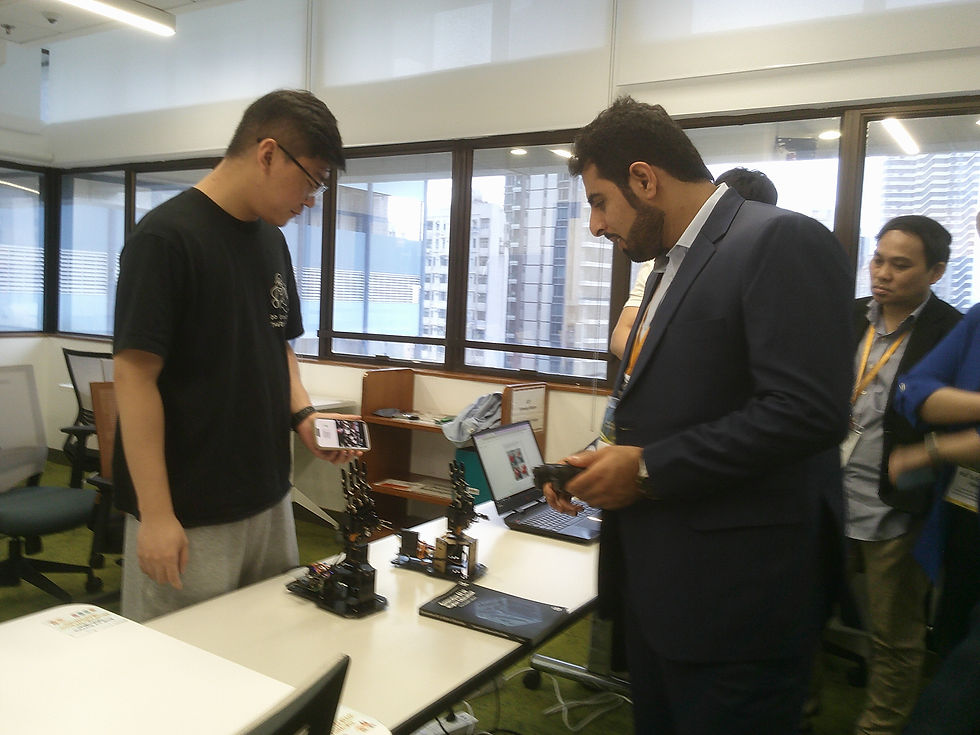

We would like to express our sincere gratitude to the international scholarship partners from the ministries of education and university admissions offices of Azerbaijan, Indonesia, Malaysia, Mongolia, Oman, Thailand, and the United Arab Emirates for their invaluable participation and their insightful perspectives!